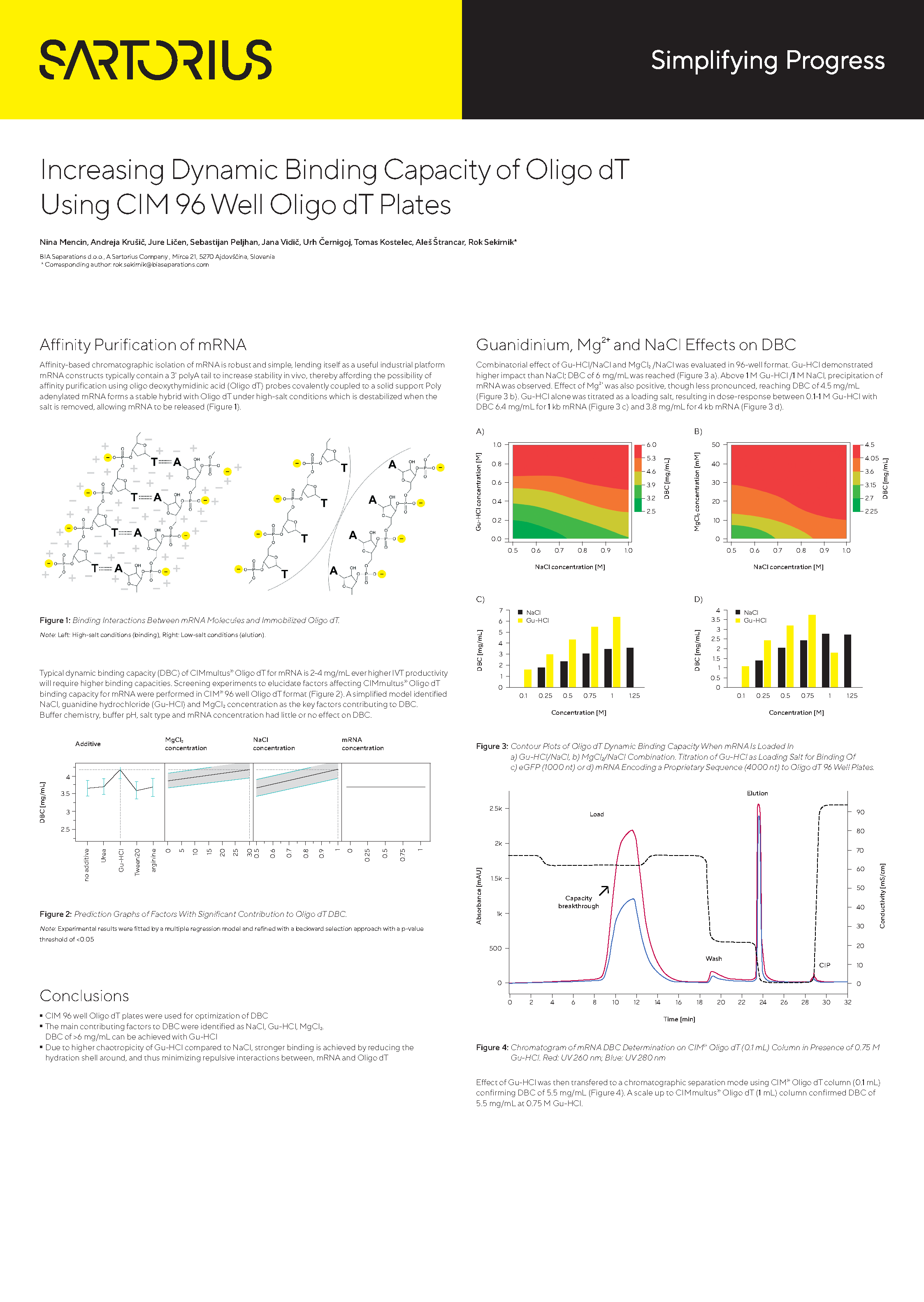
Increasing Dynamic Binding Capacity of Oligo dT Using CIM 96 Well Oligo dT Plates
- How to increase the binding capacity of Oligo dT18?
- Can a design of experiment approach be used to optimise Oligo dT binding?
- Is the monolith available in a high throughput format for liquid handlers?
- Is it possible to use a 96-well plate Oligo dT device?
Buffer conditions (salt, additives) influence mRNA binding on Oligo dT. Three contributing factors were identified and tested: NaCl, MgCl2 and Gu-HCl, the latter leading to a capacity of >6 mg/mL.
Abstract:
Affinity-based chromatographic isolation of mRNA is robust and simple, lending itself as a useful industrial platform. mRNA constructs typically contain a 3’ polyA tail to increase stability in vivo, thereby affording the possibility of affinity purification using oligo-deoxythymidinic acid (Oligo dT) probes covalently coupled to a solid support. Poly-adenylated mRNA forms a stable hybrid with Oligo dT under high-salt conditions which is destabilized when the salt is removed, allowing mRNA to be released. Typical dynamic binding capacity (DBC) of CIMmultus Oligo dT for mRNA is 2-4 mg/mL; ever higher IVT productivity will require higher binding capacities.
Screening experiments to elucidate factors affecting CIMmultus Oligo dT binding capacity for mRNA were performed in CIM 96-well Oligo dT format. A simplified model identified NaCl, guanidine hydrochloride (Gu-HCl) and MgCl2 concentration as the key factors contributing to DBC. Buffer chemistry, buffer pH, salt type and mRNA concentration had little or no effect on DBC.