
“We are very pleased to be collaborating with BIA Separations / Sartorius in developing and tech-transferring optimized mRNA vaccine manufacturing processes. When time is of the essence, it is crucial to be able to rely on key partners whilst maintaining the highest level of quality in every aspect of our work. We are also very proud that our team was able to produce two kinds of genetic vaccines (DNA and mRNA) and we look forward to expanding our partnership with the BIA Separations’ team on future projects.” – Hong Thai Pham, CEO, BioNet
Read moremRNA Process Development Services
Cornerstone Services for messenger RNA (mRNA) production ensure compliance with regulatory purity specifications. Process development is conducted at IVT scales from 100 µL to 100 mL, with standard operating procedures (SOPs) for all unit operations transferred to the customer. Comprehensive hands-on training is provided in Cornerstone labs.
The focus is on in vitro transcription (IVT) optimization to reduce costs and minimize double-stranded RNA (dsRNA) formation, using design of experiments (DOE) methodology with PATfix at-line monitoring to maximize yield. Services include optimization of the capture step (Oligo dT, multimodal), dsRNA removal, and tangential flow filtration (TFF) for drug substance (DS) formulation. Support is also available for other RNA modalities, including self-amplifying RNA (saRNA) and circular RNA (circRNA).
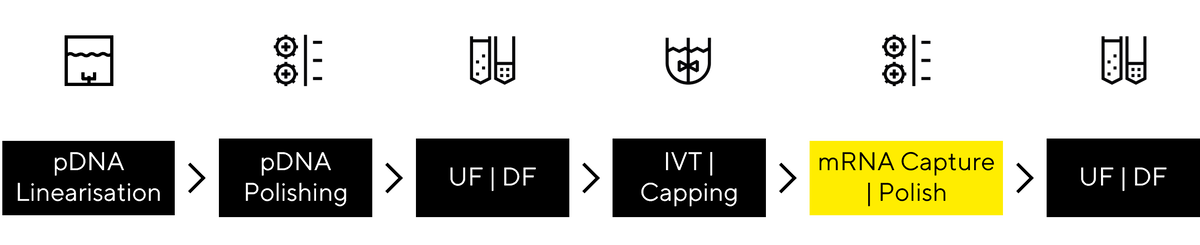
Addressing the Challenges in mRNA Process Development
In Vitro Transcription (IVT)
In the mRNA drug substance production process, the in vitro transcription (IVT) reaction is the unit operation with highest cost-of-goods profile. Enhancing mRNA yield and reducing costs requires a deep understanding of the kinetics and effects of individual IVT components, creating a need for high-throughput real-time analytics.

Cornerstone® Solution
As a multicomponent reaction, IVT is ideal for a design of experiments (DoE) approach to identify the design space and optimal reaction conditions. Key IVT conditions and reagents for optimization include pH, temperature, and the concentration and ratios of NTPs, DNA template, and Mg2+. Optimizing these factors can significantly enhance yield, affect reaction kinetics, and improve mRNA quality. Additionally, converting IVT from batch to fed-batch mode by feeding NTPs – among the cheapest reagents – can improve yield and significantly reduce mRNA production costs.

Role of Analytics
Unlike traditional single-attribute end-point analytical approaches that rely on fluorescent dye binding to mRNA, the PATfix IVT monitoring method allows chromatographic monitoring of critical IVT components throughout the reaction. With a rapid, less than 5-minute readout, capping reagents, NTPs, DNA linear template, and mRNA can be separated. This enables the study of specific reaction conditions and reagent concentrations on NTP consumption, allowing real-time monitoring of mRNA production kinetics with minimal analytical lag. Coupled with a DoE approach, a design space can be derived to support the development of mRNA therapeutics according to QbD principles. This generic analytical method applies to nucleic acid therapeutics production, including tRNA (70 nucleotides), mRNA (1000 – 5000 nucleotides), saRNA (10,000 – 12,000 nucleotides), and circular RNA. In Fed-Batch IVT reactions, where nucleotides and Mg2+ are added to boost mRNA production, IVT monitoring over time is crucial to determine optimal addition points.
In the mRNA drug substance production process, the in vitro transcription (IVT) reaction is the unit operation with highest cost-of-goods profile. Enhancing mRNA yield and reducing costs requires a deep understanding of the kinetics and effects of individual IVT components, creating a need for high-throughput real-time analytics.
Cornerstone® Solution
As a multicomponent reaction, IVT is ideal for a design of experiments (DoE) approach to identify the design space and optimal reaction conditions. Key IVT conditions and reagents for optimization include pH, temperature, and the concentration and ratios of NTPs, DNA template, and Mg2+. Optimizing these factors can significantly enhance yield, affect reaction kinetics, and improve mRNA quality. Additionally, converting IVT from batch to fed-batch mode by feeding NTPs – among the cheapest reagents – can improve yield and significantly reduce mRNA production costs.
Role of Analytics
Unlike traditional single-attribute end-point analytical approaches that rely on fluorescent dye binding to mRNA, the PATfix IVT monitoring method allows chromatographic monitoring of critical IVT components throughout the reaction. With a rapid, less than 5-minute readout, capping reagents, NTPs, DNA linear template, and mRNA can be separated. This enables the study of specific reaction conditions and reagent concentrations on NTP consumption, allowing real-time monitoring of mRNA production kinetics with minimal analytical lag. Coupled with a DoE approach, a design space can be derived to support the development of mRNA therapeutics according to QbD principles. This generic analytical method applies to nucleic acid therapeutics production, including tRNA (70 nucleotides), mRNA (1000 – 5000 nucleotides), saRNA (10,000 – 12,000 nucleotides), and circular RNA. In Fed-Batch IVT reactions, where nucleotides and Mg2+ are added to boost mRNA production, IVT monitoring over time is crucial to determine optimal addition points.
mRNA Capture Step
Cornerstone® Solution
An affinity purification method using Oligo-dT immobilized onto a monolith support effectively removes IVT impurities. This step may be preceded by a TFF step (buffer exchange, removal of low molecular weight impurities), which does not increase purity on its own compared to Oligo-dT. The stability of mRNA purified using Oligo-dT is significantly enhanced, remaining stable for several weeks at room temperature and even at 37°C, compared to mRNA purified with commercial isolation kits, which can rapidly degrade.
Alternatively, if mRNA is not polyadenylated, a multimodal column can be used, combining properties of anion exchange and hydrogen bonding.
Cornerstone® Solution
An affinity purification method using Oligo-dT immobilized onto a monolith support effectively removes IVT impurities. This step may be preceded by a TFF step (buffer exchange, removal of low molecular weight impurities), which does not increase purity on its own compared to Oligo-dT. The stability of mRNA purified using Oligo-dT is significantly enhanced, remaining stable for several weeks at room temperature and even at 37°C, compared to mRNA purified with commercial isolation kits, which can rapidly degrade.
Alternatively, if mRNA is not polyadenylated, a multimodal column can be used, combining properties of anion exchange and hydrogen bonding.
mRNA Polishing Step
Removing impurities, including shorter fragments (degradation products), residual DNA templates, and product-related impurities such as dsRNA (without DNAse).
Cornerstone® Solution
Reverse-phase chromatography using styrene divinyl benzene (SDVB) chemistry offers flow-rate independent chromatographic properties (resolution, capacity) combined with the benefits of reverse-phase chromatography for mRNA polishing. This method effectively removes undesired dsRNA contaminants from single-stranded mRNA and residual DNA templates. The binding of highly negatively charged mRNA to hydrophobic resin is enhanced with ion pairing reagents like triethylammonium acetate.
Role of Analytics
A similar chromatographic setup can be used analytically to monitor the purity of DSP products. The analytical reverse-phase method, utilizing a CIMac SDVB column, separates RNA molecules by size while operating in an ascending acetonitrile gradient.
Removing impurities, including shorter fragments (degradation products), residual DNA templates, and product-related impurities such as dsRNA (without DNAse).
Cornerstone® Solution
Reverse-phase chromatography using styrene divinyl benzene (SDVB) chemistry offers flow-rate independent chromatographic properties (resolution, capacity) combined with the benefits of reverse-phase chromatography for mRNA polishing. This method effectively removes undesired dsRNA contaminants from single-stranded mRNA and residual DNA templates. The binding of highly negatively charged mRNA to hydrophobic resin is enhanced with ion pairing reagents like triethylammonium acetate.
Role of Analytics
A similar chromatographic setup can be used analytically to monitor the purity of DSP products. The analytical reverse-phase method, utilizing a CIMac SDVB column, separates RNA molecules by size while operating in an ascending acetonitrile gradient.
Tangential Flow Filtration (TFF)
Removing salt impurities from previous chromatographic steps without compromising product integrity is crucial, especially with large, sensitive molecules like mRNA. Optimizing the TFF step is essential to achieve high product recovery and desired final concentration while minimizing the time required.
Cornerstone® Solution
For buffer exchange and concentration of chromatographically purified mRNA into the final formulation buffer, single-use TFF membranes of various sizes (e.g., 50 cm², 200 cm²) and pore sizes (e.g., 50 kDa, 100 kDa) are used to accommodate different molecule sizes and initial sample volumes. To optimize this step, a TFF system like the Sartoflow® Smart TFF System is employed to develop a scalable TFF process.
Removing salt impurities from previous chromatographic steps without compromising product integrity is crucial, especially with large, sensitive molecules like mRNA. Optimizing the TFF step is essential to achieve high product recovery and desired final concentration while minimizing the time required.
Cornerstone® Solution
For buffer exchange and concentration of chromatographically purified mRNA into the final formulation buffer, single-use TFF membranes of various sizes (e.g., 50 cm², 200 cm²) and pore sizes (e.g., 50 kDa, 100 kDa) are used to accommodate different molecule sizes and initial sample volumes. To optimize this step, a TFF system like the Sartoflow® Smart TFF System is employed to develop a scalable TFF process.
Sterile Filtration
Preventing microbial contamination and ensuring patient safety with sterile filtration solutions suitable for large, shear-sensitive mRNA molecules.
Cornerstone® Solution
The Sartopore family of filters is used for sterile filtration, offering a broad range of PES membrane combinations with a 0.2 µm final membrane pore size. These filters can be integrated into filter transfer sets for closed single-use applications.
Preventing microbial contamination and ensuring patient safety with sterile filtration solutions suitable for large, shear-sensitive mRNA molecules.
Cornerstone® Solution
The Sartopore family of filters is used for sterile filtration, offering a broad range of PES membrane combinations with a 0.2 µm final membrane pore size. These filters can be integrated into filter transfer sets for closed single-use applications.
Hear from Our Customers




Ready to Discuss the Project?
FAQ About mRNA Process Development
Our facilities are located in Wilmington, Slovenia. We can support you with process development in our modern, fully-equipped BSL 1 and 2 facilities. Take a virtual tour of our laboratories.

Yes. With PATfix mRNA platform you will be provided with internal mRNA standard mFIX4 (4000 nt). Alternatively, since UV absorbance of RNA can be sequence dependent, we recommend that you perform a calibration curve with the same molecule that you are analyzing.
We have developed an assay which makes use of exonuclease digestion that is selective for capped versus uncapped RNA. If we digest down the RNA with exonuclease we’re only left with capped RNA and so by subtraction we can work out what was the relative amount of capped mRNA.
For distinguishing between polyadenylated and non-polyadenylated molecules or for stability studies, the PATfix mRNA platform offers production monitoring analysis with CIMac Oligo dT column.
All RNA, that is longer than ~100 nucleotides, elutes in the same area with IVT monitoring method. For quality control we offer analytics with CIMac SDVB column that allows you to separate your sample by size, successfully detecting fragmentation and in some cases dsRNA.
Consult Our Experts
Our experts would be happy to discuss your project. Fill the contact form below or send us an email to support@biaseparationsinc.com