Modulating and Understanding Retention of Proteins on Chromatographic Support by Changing Cation-Exchanging Ligand
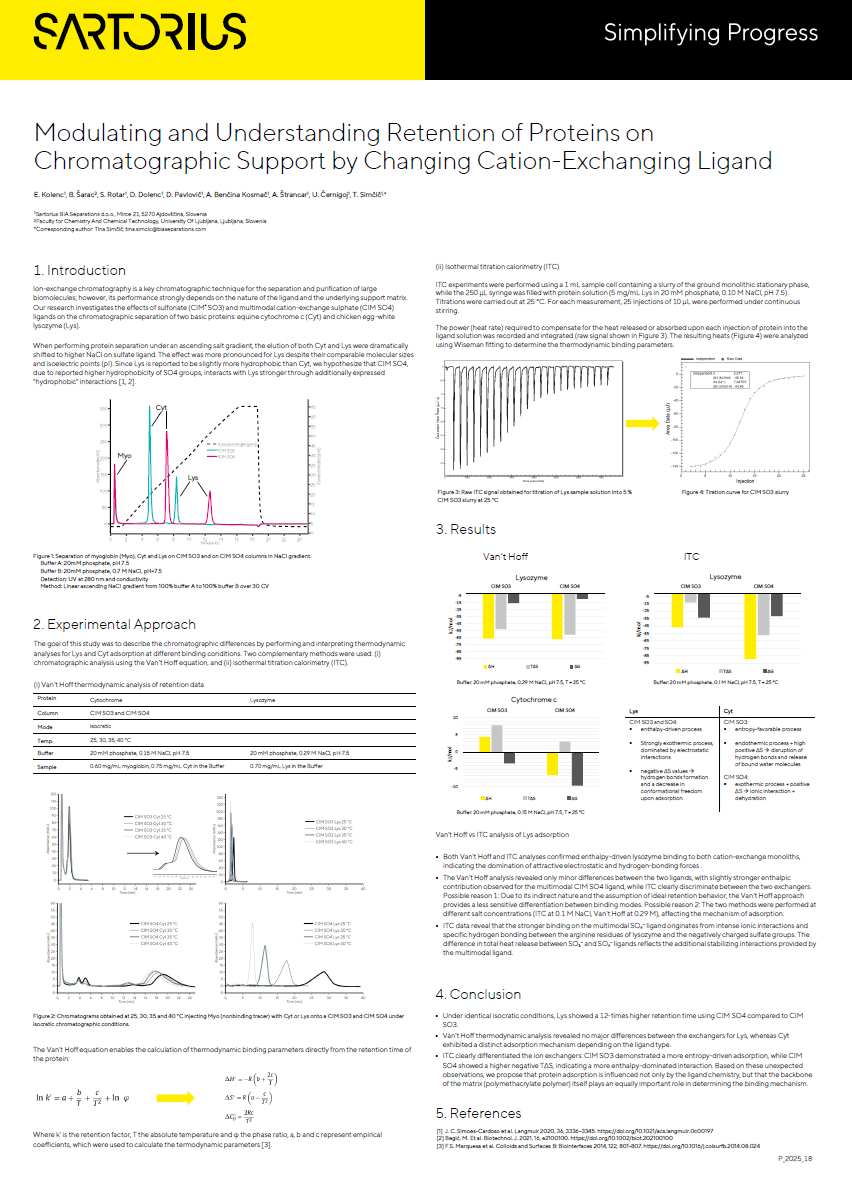
This study examines the differences in protein separation using CIM® SO3 (sulfonate) and CIM® SO4 (sulfate) monolith cation exchangers. Under an ascending salt gradient, both cytochrome c and lysozyme eluted at significantly higher NaCl concentrations on CIM SO4, with a more pronounced effect observed for lysozyme. The research aims to elucidate these differences through thermodynamic analysis, offering insights into protein–ligand and protein-matrix interactions.
The study explores how different cation-exchange ligands—conventional sulfonate (CIM SO3) and multimodal sulfate (CIM SO4)—influence the retention and adsorption behavior of two basic proteins, lysozyme and cytochrome c. Thermodynamic analysis was employed to explain variations in protein binding mechanisms. CIM SO4, a new strong cation-exchange column, introduces hydrophobic and hydrogen bond interactions alongside ion interactions. This results in the elution of positively charged biomolecules at higher conductivity values compared to standard strong cation-exchange columns.
Replacing the sulfonate ligand with a multimodal sulfate ligand led to a significantly stronger retention shift for lysozyme than for cytochrome c, underscoring the enhanced selectivity of multimodal interactions. This indicates that the CIM SO4 column could serve as an additional chromatographic tool for challenging protein separations.
*The CIM SO4 columns discussed in this study are not yet available for commercial sale.